
Efficient Water Sprinklers for Lush Gardens
Benefits of Using Water Sprinklers in Gardens
Is your lawn a patchwork of lush green and sad, brown spots? You might be watering regularly, but the secret to great lawn care isn't just about how much water you use—it's about how it's delivered. Many common garden problems stem from an inefficient watering method that leaves some areas flooded and others bone-dry.
An automatic water sprinkler system might seem complex, but it's more like a timer and some well-placed showerheads for your lawn. This guide demystifies the process in simple, practical terms. You'll learn how to choose the right sprinkler, solve frustrating dry spots, and even lower your water bill. Get ready to take control of your watering and achieve the healthy, beautiful lawn you’ve been working toward.
If you’re comparing garden watering with building safety solutions, explore a complete fire sprinkler system setup for commercial and industrial sites.
Simple Hose-End Sprinklers vs. Automated In-Ground Systems
When it comes to watering your lawn, your first decision is a big one: a simple sprinkler attached to a hose or a permanent system built into your yard? The choice boils down to your budget, yard size, and how much hands-on effort you’re willing to put in.
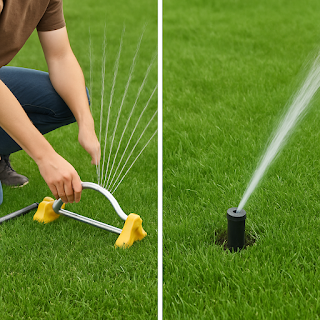
The most familiar option is a hose-end sprinkler, like the classic oscillating or impact models. These are affordable, easy to use, and perfect for smaller yards or for homeowners who don’t mind moving them to cover different spots. They offer total flexibility but require manual effort for every watering session.
On the other hand, an in-ground system is the ‘set-it-and-forget-it’ solution. This network of underground pipes and pop-up sprinkler heads is fully automated, watering your lawn on a schedule without you lifting a finger. While it’s a bigger investment upfront, an in-ground system provides the most consistent coverage and convenience, especially for larger properties.
For design, installation, and maintenance support, see our firefighting and protection systems services.
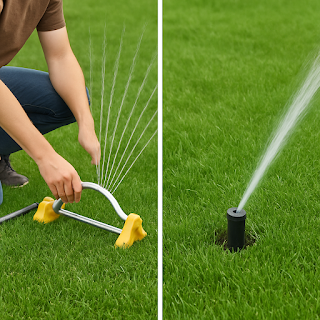
A simple side-by-side photo showing a person moving a hose-end sprinkler on one side, and unobtrusive pop-up sprinkler heads flush with the grass on the other side.
The Best Hose-End Sprinklers: Oscillating vs. Impact
If you’ve opted for a simple hose-end model, you’ll mainly find two types battling for your attention: the oscillating sprinkler and the impact sprinkler. You know them as the one that goes back-and-forth like a fan and the one that makes that classic tick-tick-tick-pssssh sound. Choosing the right one for your lawn's shape makes a huge difference.
Matching the sprinkler’s spray pattern to your yard is key. An excellent sprinkler doesn’t need to be expensive; you can find durable models for well under $50. Here’s a quick guide:
Oscillating Sprinkler
- Best for: Square or rectangular lawns.
- Spray Pattern: A gentle, rain-like curtain of water that sweeps back and forth.
Impact Sprinkler
- Best for: Large or irregular-shaped areas.
- Spray Pattern: A powerful, rhythmic stream that can be adjusted to cover a full or partial circle.
Hose-end sprinklers are fantastic tools for most small to medium-sized yards. However, if you find yourself constantly moving the sprinkler to chase dry spots, it might be time to consider the pop-up heads that make automated systems so convenient.
Decoding Your Yard: What Are "Pop-Up" Sprinkler Heads?
If you’ve ever seen a lawn sprinkler appear out of nowhere, you’ve witnessed a pop-up head in action. These are key parts of permanent irrigation systems. The main body of the sprinkler is installed underground, with the top sitting flush with the soil, keeping them safely hidden from foot traffic and your lawnmower.
The pop-up action is driven by water pressure. When your system turns on, the force of the water pushes a small cylinder up and out of the protective body. When the water shuts off, the pressure is released and a spring pulls the head back down. This design provides a neat, effective, and automated watering solution without cluttering your yard.
The "Showerhead" vs. The "Watering Jet": Choosing the Right Pop-Up Head
While all pop-up heads hide in your lawn, they don’t all spray water the same way. The two main types of sprinkler heads for lawns, spray heads and rotor heads, are designed for very different jobs.
A spray head is like a gentle showerhead for your grass. It fans out water in a fixed, stationary pattern and is perfect for smaller, defined spaces like flower beds or the narrow strip of grass between the sidewalk and the street.
For covering a lot of ground, you need a rotor head. A rotor shoots out a single, powerful stream of water that rotates across the landscape. This allows it to cover a much larger radius, making it the ideal choice for big, open backyards. Using one rotor is far more efficient for large spaces than placing dozens of smaller spray heads.
The secret to eliminating brown patches is ensuring the spray from one sprinkler head reaches the next one. This "head-to-head coverage" ensures every inch of your lawn gets a consistent drink. Of course, these heads rely on a central command center to tell them when to turn on.
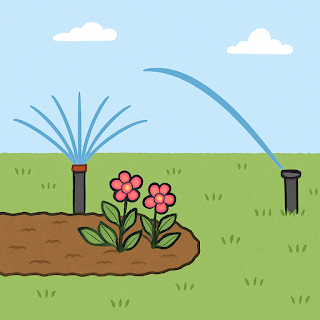
A simple illustration showing a spray head with a fan-like spray pattern over a small flower bed, and a rotor head with a long, single stream of water arcing across a large lawn.
The Brain of Your System: How a Smart Controller Can Cut Your Water Bill
That box in your garage, the sprinkler controller, is the brain of your entire operation. A basic timer simply tells sprinklers to run for a set time on certain days, which means it will water your lawn during a downpour just as willingly as during a dry spell, wasting a tremendous amount of water.
This is where an upgrade to a smart controller makes a huge difference. By connecting to the internet, it actively checks your local weather forecast. If it rained yesterday or a storm is due tomorrow, it automatically skips the next watering cycle. This simple intelligence is a major benefit, with many homeowners saving 30% to 50% on their summer water bills by preventing unnecessary watering.
A smart system takes the guesswork out of watering and ensures your lawn gets exactly what it needs without waste. But you might have noticed that your whole yard doesn't get watered at once. This isn't an accident; it's a crucial feature known as "zoning."
Why Your Yard Waters in Sections: The Magic of 'Zones'
That staggered watering schedule, where one section of your lawn is watered and then another, is completely intentional. Your sprinkler system is divided into sections called zones. Think of a zone like a light switch for a specific room—you only turn on the lights for the room you're in. Your controller only activates one zone at a time.
The reason is water pressure. If every sprinkler head tried to run simultaneously, the pressure would drop so much that you'd get weak, ineffective sprays. Grouping sprinklers into zones is the built-in solution that guarantees every sprinkler has enough power to pop up and distribute water evenly across its designated area.
This zoning principle also allows you to deliver different amounts of water to areas with different needs, like a thirsty lawn versus a bed of delicate flowers.
Delicate Flowers vs. Hardy Lawns: Drip Irrigation or a Sprinkler System?
Not all plants have the same thirst. While sprinklers are great for lawns, they can be too powerful or wasteful for a vegetable garden or a row of shrubs. Using a powerful spray on delicate flowers is like using a firehose to water a houseplant—it’s the wrong tool for the job.
This is where drip irrigation comes in. Instead of spraying water, a drip system uses tubes with small emitters that deliver water slowly and directly to the soil at each plant's roots. This is the core of the drip irrigation vs. sprinkler system debate: targeted delivery versus broad coverage.
A well-designed system often uses both types in different zones:
- Use Sprinklers for: Lawns and large, uniform groundcover areas.
- Use Drip Irrigation for: Vegetable gardens, flowerbeds, potted plants, and rows of shrubs.
By delivering water directly to the roots, drip irrigation dramatically reduces water lost to wind and evaporation and keeps moisture off leaves, which helps prevent disease. This targeted approach ensures your most delicate plants get exactly what they need, without wasting a drop.
Water Smarter, Not Harder: The Secret to an Efficient Watering Schedule
Knowing which sprinkler to use is only half the battle; knowing when to use it is the other. If you run your sprinkler in the middle of a hot, sunny day, much of that moisture evaporates before it can soak into the soil. For this reason, the best time to water is in the cool of the early morning, ideally before 9 a.m.
While it might seem just as cool, watering at night is a major lawn care mistake, as a lawn that sits wet for hours is a perfect breeding ground for fungus and disease. Now that you know when to water, the next question is for how long. The perfect solution is a simple diagnostic called the "Tuna Can Test."
The "Tuna Can Test": A 5-Minute Fix for Brown Spots and Puddles
Frustrating brown spots often appear right next to soggy, overwatered patches. This indicates your water isn't being spread evenly across a zone. The "Tuna Can Test" is a simple way to see exactly where your water is going.
To perform the test, grab a few empty, flat-bottomed containers like tuna or cat food cans:
- Place 5-6 empty cans randomly throughout a single sprinkler zone.
- Run that zone for exactly 15 minutes.
- Check the cans. Is the water level in each one roughly the same?
If you find a big difference—one can nearly full while another is almost empty—you've found the source of your lawn problems. This imbalance points directly to a sprinkler head that's clogged, blocked by tall grass, or aimed in the wrong direction.
Your 3-Minute Sprinkler Check-Up: An Easy Maintenance Checklist
Now that you know how to spot uneven watering, a little proactive care can prevent those issues from starting. A few minutes of observation each month can save you from a dead patch of grass or a surprise geyser on your front lawn.
The next time you water, take a quick stroll and use this simple maintenance checklist:
- Watch Each Zone: Look for pop-up sprinkler heads that don’t rise, don’t spray, or are spraying wildly in the wrong direction.
- Clean a Clogged Head: Gently wipe away any dirt or grass clippings built up around the nozzle—this is a top cause of poor spray patterns.
- Check for Leaks: Notice any new puddles or constantly soggy spots? This points to a broken head or a leak in the line.
- Adjust for Growth: Make sure tall grass or overgrown shrubs aren’t blocking the spray from reaching its target.
Need certified equipment and accessories? Browse fire protection products here.
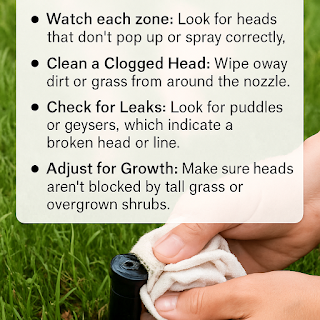
A close-up photo of a person's hand using a soft cloth to wipe dirt and grass clippings away from the top of a pop-up sprinkler head.
Gain Confidence in Your Watering Strategy
Those once-confusing brown spots and high water bills no longer have to be a mystery. Where you once saw a problem, you can now see a system you understand—from the controller’s schedule to the specific job of each sprinkler head. This knowledge gives you the power to spot issues and fine-tune your watering.
Put this guide into practice with one simple action: check what time your system runs. By shifting your watering to the cool, early morning hours, you’ll immediately make your system more efficient. Each small adjustment you make is now an informed choice, not a shot in the dark. You are equipped to cultivate a healthier lawn with confidence.
You can also explore our full supply catalog for related engineering and safety products.